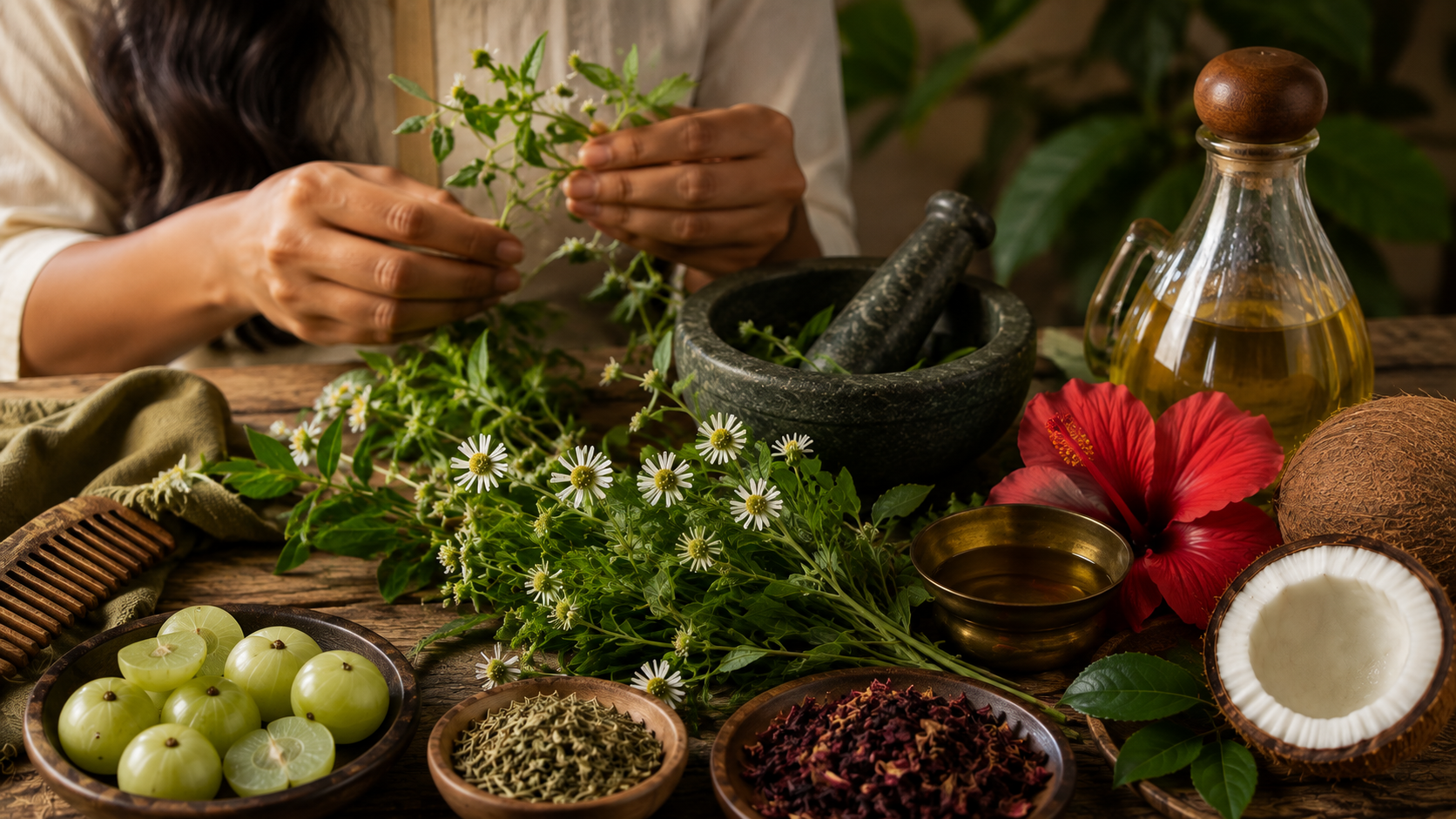
Some Ayurvedic formulations contain a long list of ingredients.
Triphala isn’t one of them.
Its recipe is surprisingly simple.
Just three fruits:
- Harad (Terminalia chebula)
- Baheda (Terminalia bellirica)
- Amla (Emblica officinalis)
That’s it.
Yet this combination has remained one of the most recognized formulations in Ayurveda for centuries.
Why?
Part of the answer lies in Ayurveda’s approach to wellness.
Traditional Ayurvedic practices don’t usually focus on isolated symptoms. Instead, they pay attention to balance, routine, digestion, nourishment, and daily habits.
And that’s where Triphala enters the conversation.
The word itself offers a clue.
“Tri” means three.
“Phala” means fruits.
Together, they create a formulation that has become deeply woven into Ayurvedic traditions.
If you’ve spent any time exploring Ayurveda, you’ve probably come across these three ingredients before.
Harad has a long history in traditional herbal practices.
Baheda has been used in Ayurvedic formulations for generations.
Amla is perhaps the most recognizable of the three and appears in everything from wellness supplements to hair care products.
What’s fascinating is that each fruit has its own identity, yet they continue to be used together.
That combination has remained remarkably consistent over time.
And that’s unusual.
Health trends change constantly.
One year, everyone is talking about a newly discovered superfood.
The next year, something else replaces it.
Triphala has quietly avoided that cycle.
It has continued to occupy the same place it always has.
Another interesting thing about Triphala is that people often discover it while looking for something completely different.
Someone starts reading about digestion.
Another person begins researching traditional Ayurvedic formulations.
Someone else notices Amla listed on a supplement label.
Eventually, all of those paths seem to lead back to Triphala.
Perhaps that’s one reason it has remained so relevant.
It’s simple.
It’s familiar.
And it’s deeply rooted in tradition.
There’s also something refreshing about a formulation built around only three ingredients.
No complicated blends.
No endless ingredient lists.
Just Harad, Baheda, and Amla.
Sometimes, simplicity is exactly what makes something memorable.
How Testohold fits into this
Testohold Triphala Capsules combine these three traditional ingredients in a convenient capsule form.
The formulation contains Harad (Terminalia chebula), Baheda (Terminalia bellirica), and Amla (Emblica officinalis), staying true to one of Ayurveda’s most recognized combinations.

If you’ve been curious about Triphala but don’t want to prepare traditional formulations at home, capsules offer a simple way to incorporate this classic Ayurvedic preparation into your daily routine.
Explore more Ayurvedic wellness products at Testohold.com.
For product information, call +91 85449 60024.
Frequently asked questions
What does Triphala mean?
The word Triphala literally means “three fruits.”
What are the three ingredients in Triphala?
Traditional Triphala contains Harad (Terminalia chebula), Baheda (Terminalia bellirica), and Amla (Emblica officinalis).
Why is Triphala so popular in Ayurveda?
It has been part of traditional Ayurvedic practice for centuries and remains one of the best-known herbal formulations.
Is Amla part of Triphala?
Yes. Amla is one of the three fruits used in the traditional formulation.
Why do people still use Triphala today?
Many traditional formulations continue to be used because they have remained part of everyday wellness practices across generations.