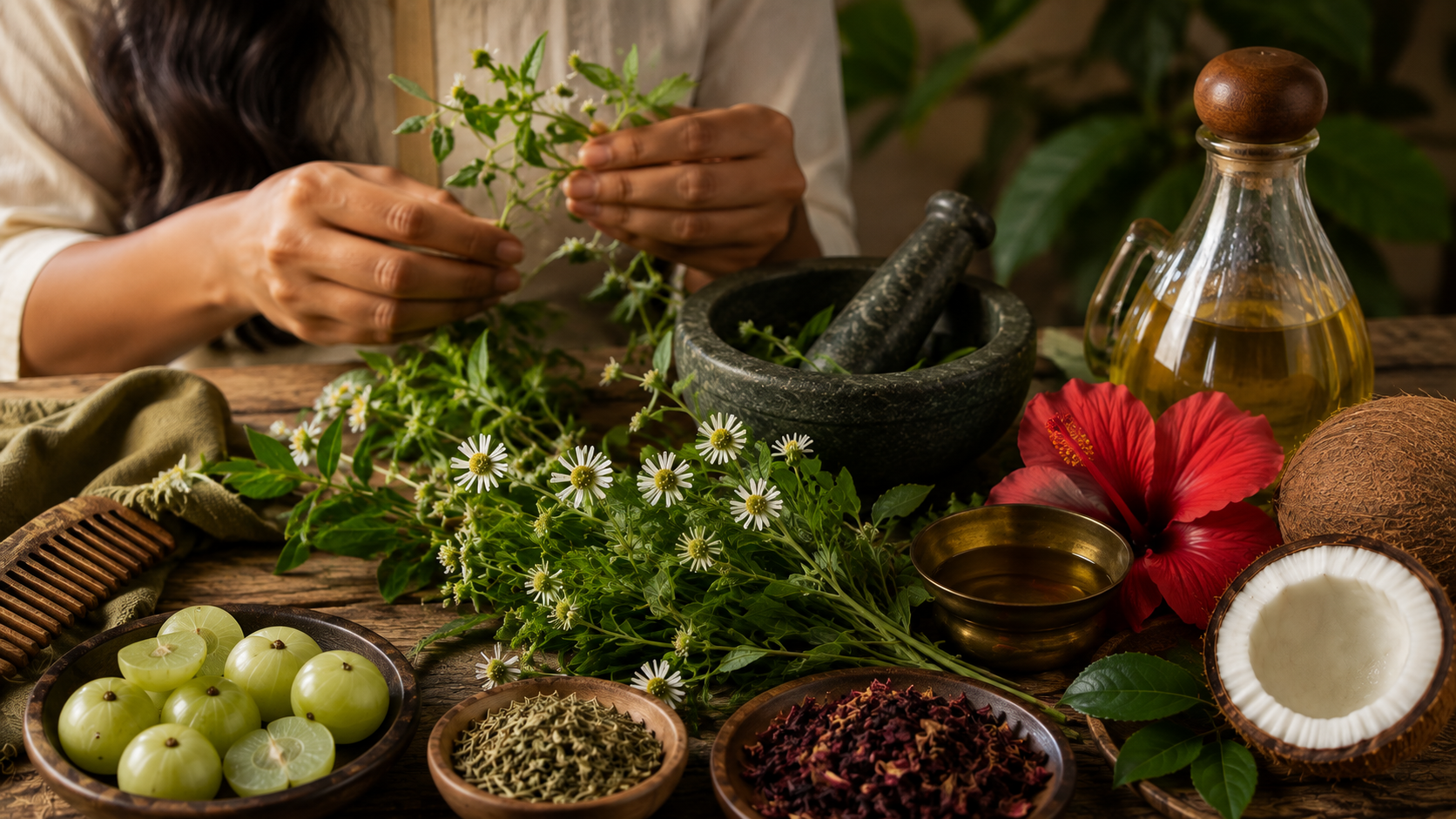
If you grew up in an Indian household, you’ve probably heard the word Bhringraj at some point.
Maybe it came up during a conversation about hair fall. Maybe your grandmother used to warm a small bowl of oil before applying it to your scalp. Or perhaps you’ve noticed that many Ayurvedic hair oils still include it as one of their key ingredients.
What’s interesting is that Bhringraj hasn’t disappeared despite the arrival of modern hair serums, masks, leave-in conditioners, and countless new products promising quick results.
That says something.
Some ingredients survive because they’re fashionable. Others survive because people keep returning to them, generation after generation.
Bhringraj belongs to the second category.
Also known as Eclipta alba or Eclipta prostrata, Bhringraj has been part of Ayurvedic traditions for centuries. Over time, it earned a nickname that still follows it today: the king of herbs for hair.
That’s a bold title for any plant to carry.
But Ayurveda has always viewed hair care a little differently.
Instead of treating hair as a separate cosmetic concern, Ayurveda looks at the entire system. Daily habits, sleep, stress, scalp care, nutrition, and the ingredients used on the hair all contribute to the bigger picture.
That’s one reason Bhringraj rarely appears alone.
Look at traditional Ayurvedic hair preparations, and you’ll often find it combined with ingredients such as Amla, Brahmi, Neem, Hibiscus, Methi, and coconut oil.
Each ingredient has its own history.
Amla has been used in Indian beauty practices for centuries. Brahmi is well known in Ayurvedic formulations. Neem has been part of personal care traditions for generations. Hibiscus flowers have been used in homemade hair preparations in countless households across the country.
When these ingredients are combined, they create a more balanced formulation than a single herb used in isolation.
There’s another reason Bhringraj continues to remain relevant.
It reminds us of a time when hair care wasn’t rushed.
Applying hair oil used to be a ritual rather than another task on a checklist.
Warm the oil.
Massage it gently into the scalp.
Sit for a while.
Leave it overnight if you prefer.
Wash it the next morning.
Simple.
There was no complicated ten-step routine. No shelf full of products.
Just a few ingredients that people trusted and a little time set aside for self-care.
That practice still has value.
Even today, spending 15 or 20 minutes massaging your scalp once or twice a week can feel surprisingly relaxing.
If you’re planning to add Bhringraj to your routine, don’t focus only on the name printed on the label.
Turn the bottle around and read the entire ingredient list.
Traditional Ayurvedic formulations were rarely built around a single ingredient. They combined multiple herbs because they were meant to work together.
Patience matters, too.
Hair care isn’t usually about dramatic overnight changes.
Consistency often matters much more than intensity.
A simple routine followed for months will almost always outperform an ambitious routine that lasts for two weeks.
How Testohold fits into this
Reading about Bhringraj is easy.
The real question is: how do you actually include it in your routine?
One option is to choose a hair oil that combines several traditional Ayurvedic ingredients rather than relying on a single herb.
Testohold Hair Oil brings together Bhringraj, Amla, Brahmi, Methi, Neem, Hibiscus, Jatamansi, and coconut oil in one Ayurvedic blend.
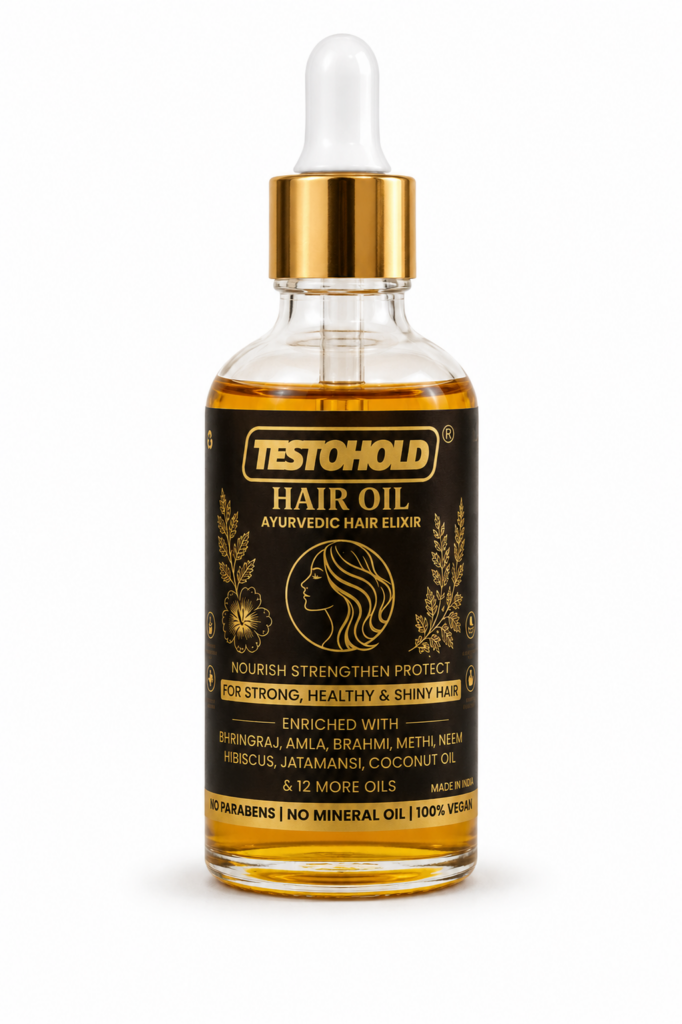
Instead of highlighting one “hero ingredient,” the formula follows a more traditional approach by combining multiple botanicals that have long been used in Ayurvedic hair care.
If you’re already using hair oil, consider taking an extra five minutes to massage it into your scalp rather than applying it quickly and moving on.
Sometimes, it’s the routine itself that becomes just as valuable as the ingredients.
Explore more Ayurvedic wellness products at Testohold.com.
For product information, call +91 85449 60024.
Frequently asked questions
What is Bhringraj?
Bhringraj is an Ayurvedic herb known scientifically as Eclipta alba or Eclipta prostrata. It has been used in traditional hair care practices for centuries.
Why is Bhringraj called the king of herbs for hair?
The nickname comes from its long association with hair and scalp care in Ayurvedic traditions.
Can Bhringraj be combined with other herbs?
Yes. It is commonly combined with ingredients such as Amla, Brahmi, Neem, Hibiscus, Methi, Jatamansi, and coconut oil.
How often should hair oil be applied?
There isn’t one correct answer. Some people apply oil once a week, while others prefer two or three applications depending on their routine and personal preference.
Should I choose a single-ingredient hair oil?
Many traditional Ayurvedic formulations combine several herbs rather than focusing on one ingredient. Reading the complete ingredient list can help you understand how a product is formulated.